
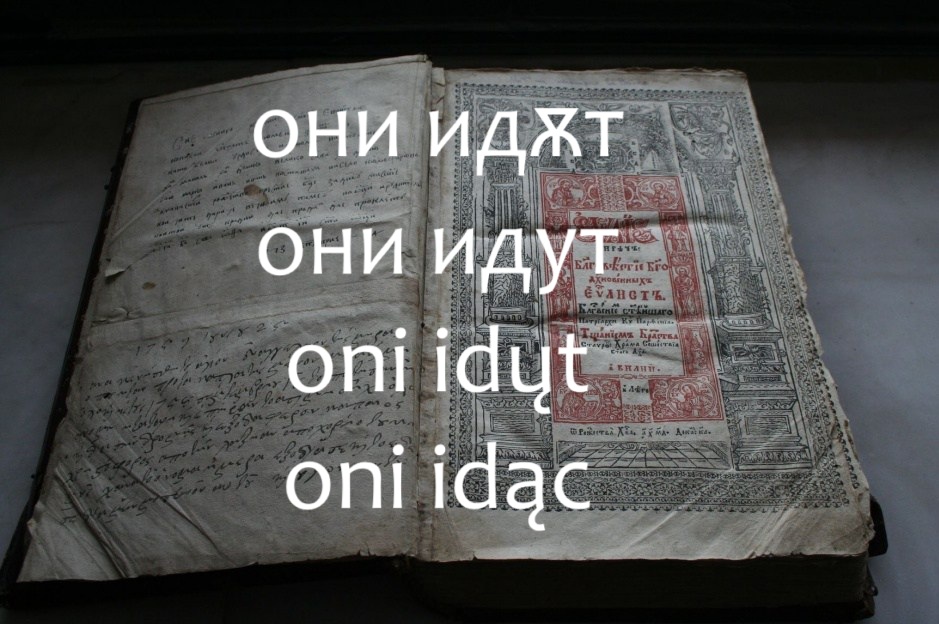
Istorija nosovych samoglasn je nešto divna. Čemu archaična forma "идѫт" změnila se v polske "idąc" (aktivne pričastie - active participle) ale takže v rosijske "идут" (glagol v tretej osobe) čto označaje ine funkcije?
Najprv treba skazať, že nosove samoglasny isnovaly v jazyke staroslovianskim. Do dnes su ich tropy v slovach takych kak "mint" (slk. mäta, pol. mięta), "meat" (slk. mäso, pol. mięso), "five" (slk. päť, pol. pięć), "heel" (slk. päta, pol. pięta). Ja sem daže vidiel komentar v internete že "polski jazyk deržy unikalne tradicije nosovych samoglasek". Faktično, v jazyke polskim jest ich najbolje, ale isnuju takže v jazyku kašebskom na primer jãzëk. Generalno ę = ä = ã = kirilične ѧ.
Druga nosova samoglasna to ų - kirilične ѫ. Jestvovala ona v jazyku staro cerkevno slovianskim v slovach: rųka рѫка (hand), pųť пѫть (path/way).
Može tak uživať by klasične nosove samoglasky daže v latinskom pisme i pisať kirilične bukvy ktore ne imaju svoich ekvivalentov v pisme latinskim? Na priklad rѫka (hand), kѫt (angle), mѫž (husband), pѧť (five), jѧzyk (language), pѫť (path), mѧso (meat), mѧta (mint)?
Reši to velmi seriozny problem konfliktovy medz narodnymi jѧzykami. Jedny choču pisať jazyk, ini jazyk. Kde je pravda? A tak pišeme jѧzyk i problema nema.
Ale najbolje seriozny problem isnuje s deklinacju glagolov v pervej jedinstvenej osobe i tretej dvojnej. Historicko treba bylo govoriť tak (pravilna deklinacija):
| ja | govoriѧ |
| ty | govoriš |
| on | govori |
| my | govorime |
| vy | govorite |
| oni | govoriѫ |
I tak deklinacija "govoriѧ" zmenila se v govorim, bo bukva ѧ jest podobna do latinskego m. V jazyku slovenskim treta osoba "govoriѫ" zmienila se v "govorijo" a v polskim w "gwarzą" kde "ą" treba čitať ako "ǫ" (gvariǫ). Vrniť se do pradavnych samoglasek, či zabyť je i ostaviť v starodavnej minulosti? Su one take krasne ale vse ľudi musieli by se ich naučiť.
Pytanie v teme nosovych samoglasek bylo dane v internetu a odgovory koristnikov su v jazyku anglijskim:
The verb form "идут" (they go) in Russian and "идуць" (oni idą, they go) in Polish or other Western Slavic languages like Belarusian has diverged in meaning due to historical phonological and grammatical developments in different Slavic branches.
1. Eastern Slavic Development (Russian, Ukrainian, Belarusian)
In modern Russian, "они идут" (oni idut) means "they are going" in a concrete sense, indicating movement happening right now. It comes from the Old East Slavic verb "идти" (to go). The archaic form "идѧтъ" (idjătŭ) evolved into "идут" in Russian.
2. Western Slavic and Southern Slavic Changes
In Polish, the equivalent verb "idą" (they go) also comes from the same Proto-Slavic root *idǫtъ, but in Belarusian and Ukrainian, the preserved form "идуць" (iduć) took a slightly different meaning.
3. Meaning Shift in West vs. East Slavic
In West Slavic (e.g., Polish), "idą" retains the present tense meaning of "they go," but in some dialects of Belarusian and Ukrainian, "идуць" started to take on a habitual or future connotation. This happens because West Slavic languages developed a clearer aspectual distinction, while East Slavic languages relied more on prefixation and auxiliary verbs to indicate aspect.
4. Orthographic and Phonetic Influence
Old Church Slavonic and Cyrillic scripts influenced East Slavic languages, keeping "идут" closer to its original form.
In contrast, Belarusian and Polish underwent phonetic changes where "iduć" (идуць) developed differently due to phonetic shifts in nasal vowels and verb endings.
In short, this divergence is due to both phonetic evolution and grammatical shifts that occurred as Slavic languages split into different branches.
First line was the Bulgarian spelling until the Soviet occupation and dictatorship after ww2. When the uneducated lowest classes came to power, they adopted the Russian "those letters are for the aristocracy - remove them". However, this letter was at the time consolidating northern and southern Bulgarian accents and one could decide where to pronounce it as A or as Ъ. The letter did evolve into pronouncing mostly as Ъ, but due to Soviet imperialism and assimilation, it is written as A in verbs, such as the one in the example.
,,ИД,,- GO +,,JьТ,, - ing(contilius) = ИДЈьТ - GOING..... two-voice ,,Ѫ,, - ус(ас)... ДѪТ-ДАсТ-ДУсТ - normal tempo ... ИД+ДасТ(ДУсТ)= ИДДАсТ- go and keep the tempo..... ,,сT,,= ,,Ц,,(latin,,C,,).... ONI IDAC..